By: Abdelrahman Elabd
September 18, 2025

Zurich, Switzerland -The cutting edge of computing and instrumentation has enabled fields like high-energy physics (HEP), multi-messenger astronomy (MMA), and even materials science to generate increasingly complex, high-resolution and high-frequency datasets – projecting reality onto a more expressive and higher-dimensional representation than ever before. Our finite storage capacity, bandwidth, and response time calls for hardware-accelerated machine learning (ML) inference to enable real-time processing and control of this new generation of science experiments. The 2025 Fast Machine Learning for Science conference, held at ETH Zurich from September 1-5, spotlighted groundbreaking advancements in both the development and application of these “FastML for Science” algorithms. A3D3 scientists and engineers discussed fundamental engineering efforts to develop faster science workflows, as well as domain-specific applications of these accelerated workflows – contributing a total of 11 talks and 6 posters, one of which received a best poster award.
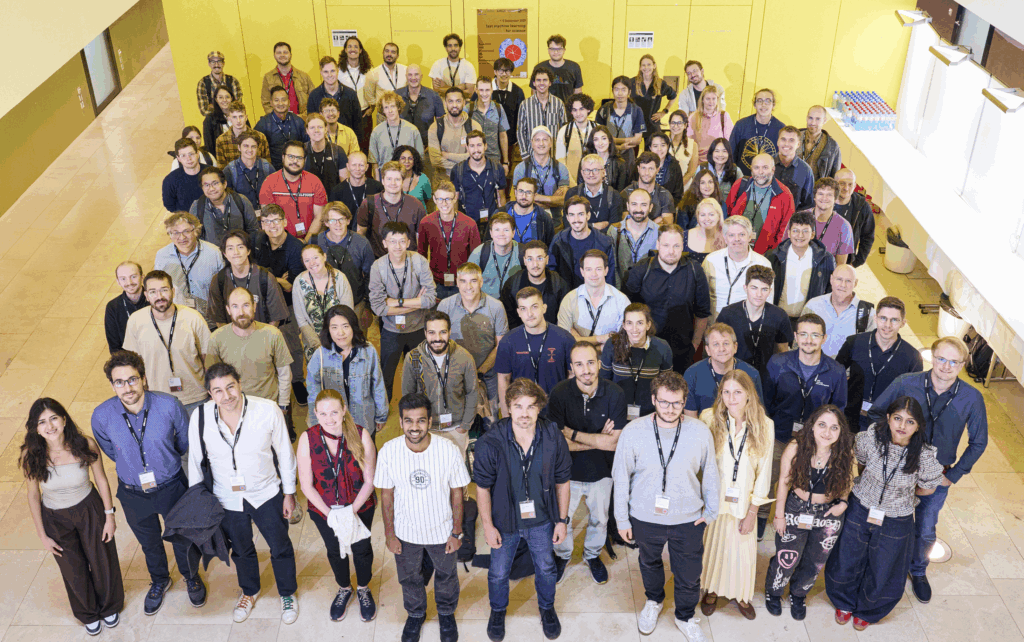
Conference photo: FastML for Science 2025

Contributed Talks

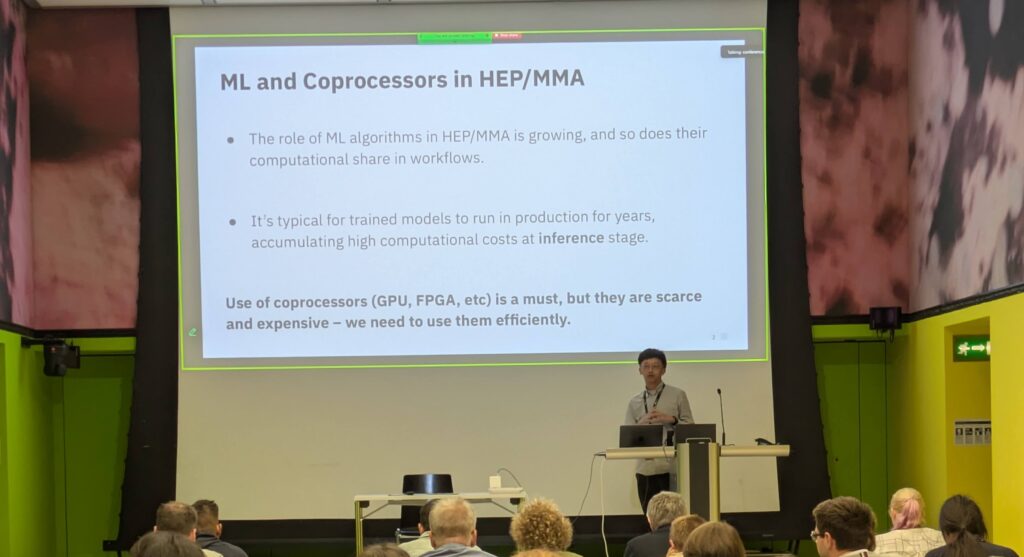
Among the distinguished contributors was Yuan-Tang Chou, who presented the highly impactful SuperSONIC framework—an infrastructure for scalable deployment of ML inferencing on Kubernetes clusters with GPUs. This platform optimizes resource utilization in experiments at CERN’s Large Hadron Collider and other scientific observatories. [paper link, project link]
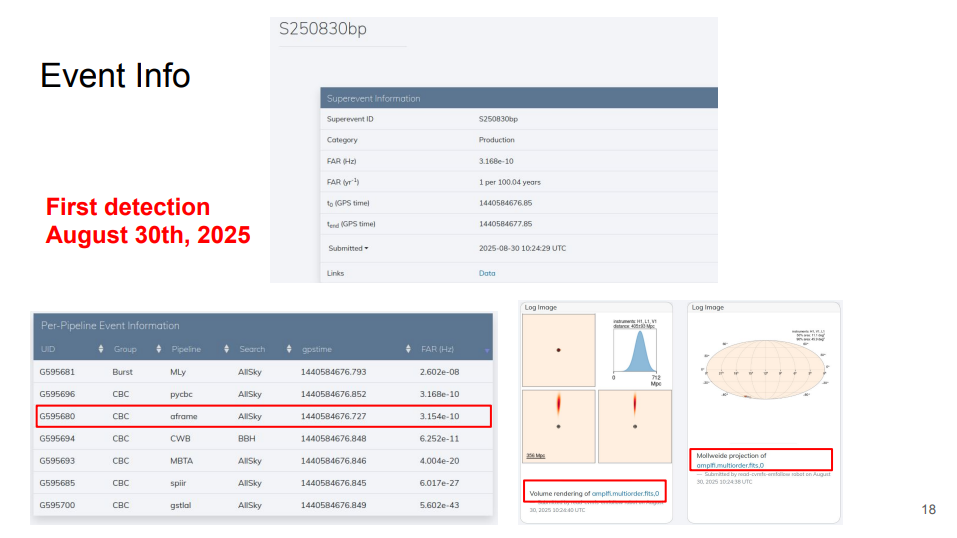
Christina Reissel presented an ML pipeline for real-time gravitational wave alerts, reacting to early-messenger astronomy signals by directing other observatories and experiments across the globe to turn their telescopes and antenna toward incoming, often short-lived signals. She also announced the recent first detection enabled by this pipeline – a gravitational-wave signal from a likely neutron star merger! This work showcases how low-latency ML allows MMA researchers to collect more and better data by enabling faster response times. [project link]
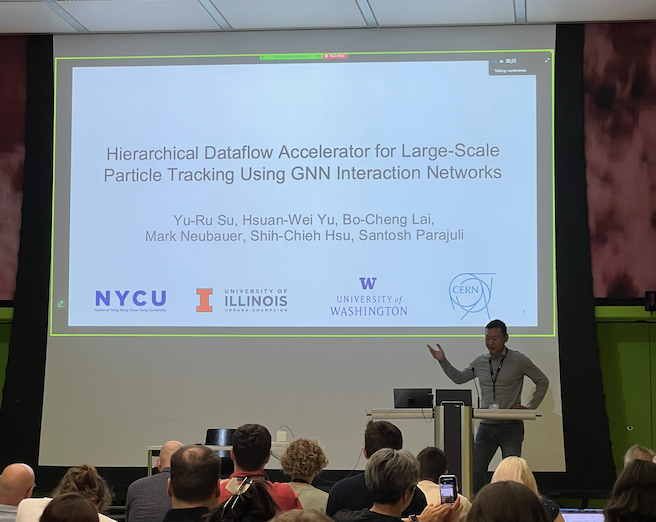
Bo-Cheng Lai reported on a hierarchical dataflow accelerator for large-scale particle tracking on FPGAs at the LHC, demonstrating orders of magnitude speedup over CPU, GPU, and less-optimized FPGA baselines. This work emphasized the importance of high-level optimization and engineering for hardware-accelerated algorithms – it’s more than just choosing a specific hardware accelerator!
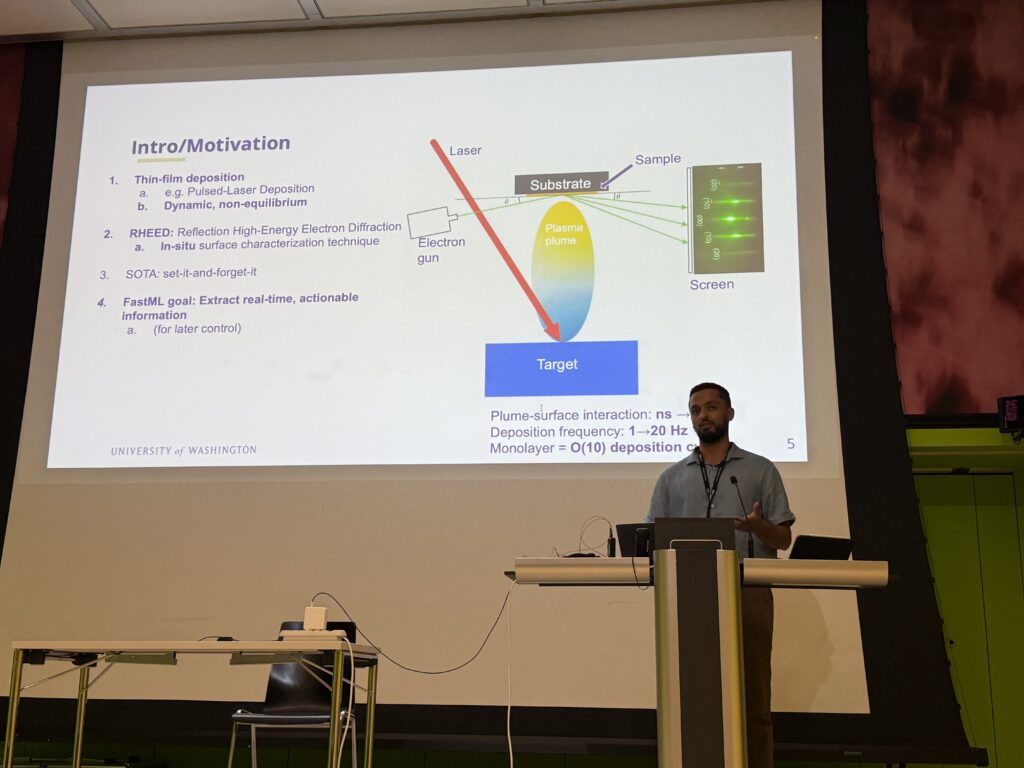
Abdelrahman Elabd introduced an FPGA algorithm for a novel science application of FastML – real-time in-situ characterization of materials being grown via thin-film deposition. This algorithm achieves sufficient latency and throughput to enable real-time monitoring and control of dynamic, non-equilibrium growth processes such as pulsed-laser deposition. This work is an example of R&D by HEP and MMA researchers bleeding into and benefiting other fields of science!

Katya Govorkova presented an ML-based compression algorithm that also denoises and extracts timing-information from photomultiplier tube pulses at the LHCb detector. The algorithm satisfies both the latency constraints and the resource-usage constraints of the radiation-hard PolarFire FPGAs on the detector – making this a promising approach for Upgrade II of LHCb, after which a huge 200 Tb/s data rate is expected during the future High-Luminosity phase of the LHC.
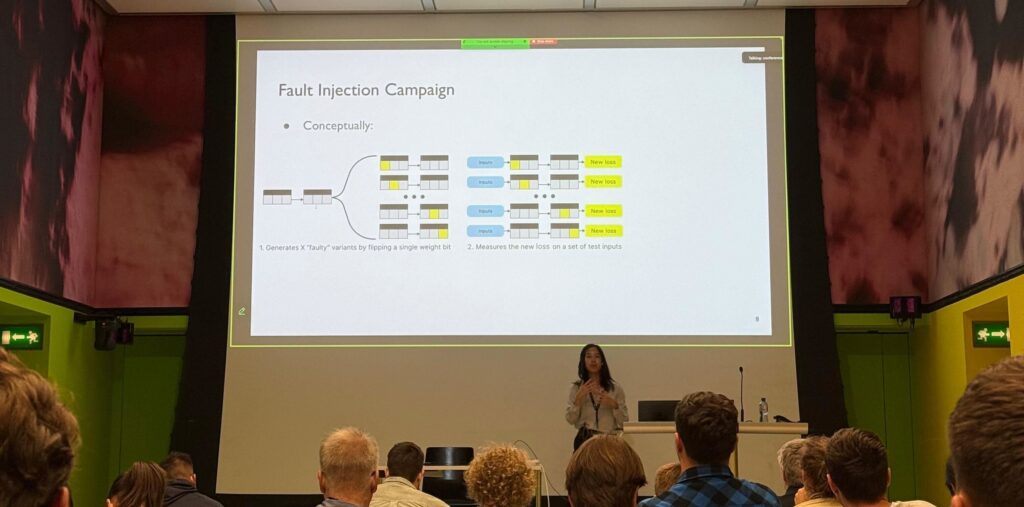
Olivia Weng discussed PrioriFi, an efficient fault injection framework to inspect and estimate bit-flip-sensitivity of edge-AI algorithms, allowing one to tune and optimize the efficiency-robustness tradeoff. PrioriFI enables designers to quickly evaluate different NN architectures and co-design fault-tolerant edge NNs.

Kenny Jia discussed how the Generic Event-Level Anomalous Trigger Option (GELATO) can  improve sensitivity to new physics at the ATLAS experiment. This work highlights how data volumes at the Large Hadron Collider (LHC) allow for unsupervised machine learning to significantly enhance the trigger system.

Duc Hoang unveiled a look-up-table (LUT) based compression workflow for Kolmogorov-Arnold Networks (KANs) on FPGAs, offering significant improvements in hardware efficiency for ultra-low latency inference.

Eric Moreno introduced the COLLIDE-2V dataset, a huge dataset of 750 million simulated collision events, providing a universal event representation and enabling development across the entire LHC data stack – from training collider foundation models, to developing anomaly-detection triggers, among many other things. This work is a crucial step in the right direction for consolidating the wide variety of LHC data workflows. [Huggingface link]

Jan-Frederik Schulte discussed an accelerated transformer architecture tailored for particle-tracking on FPGAs based on point-cloud input data. The model achieves microsecond latency on AMD/Xilinx FPGAs by leveraging hls4ml technology and model compression strategies such as pruning and quantization-aware training (QAT).

Ho-Fung Tsoi introduced SparsePixels, a framework for training and deploying efficient convolutional neural networks (CNNs) for sparse data on FPGAs. SparsePixels implements a special class of CNNs that dynamically select and compute only on active pixels (non-zero or above a threshold). It demonstrated accuracy comparable to standard CNNs while achieving orders of magnitude lower latency on FPGAs for datasets with fewer than ~5% active pixels.

Posters

Erdem Yigit Ertorer also discussed data compression at the High-Luminosity LHC (HL-LHC), introducing an autoencoder-based compression algorithm for high-granularity calorimeter data.

Jared Burleson and Hao-Chun Liang discussed two more innovative approaches for high-throughput particle-tracking at the high-level trigger (HLT) of the HL-LHC: graph neural networks (GNNs) on FPGAs and Kalman-Filters on GPUs, respectively.

Yuan-Tang Chou and Christina Reissel each presented once more, on efficient point-transformers for charged-particle reconstruction and state-space models for time-series applications, respectively, with Yuan-Tang’s poster winning 2nd place in the best poster award!

Takeaway

The FastML conference at ETH Zurich underscores the ever accelerating fusion of AI, state-of-the-art electronics, and experimental science. As we head toward a future where science experiments produce exponentially more data at exponentially faster speeds, only with the right research and development can we translate that vast data into deep insights that illuminate the dark secrets of our universe. A3D3 stands as a central institution in this push toward the future.

For additional details, each speaker’s contributions and talks are catalogued in the conference’s event site.

By: Dylan Rankin
February 21, 2024

The Reach of High Energy Physics

The A3D3 institute innovates in AI to enable discovery across science, with high energy physics (HEP) being one of the three research thrusts. Within the field of HEP there are a dizzying array of research topics and the tools physicists must use to study them are equally so. There are experiments in HEP that collide particles traveling near the speed of light and study the aftermath of the collisions to search for hints of new phenomena. Other experiments observe the vast reaches of space to try to understand the forces that shaped our universe. And still others seek to detect and measure incredibly rare interactions of elusive particles with our world that might shed light on the most mysterious known particle, the neutrino. These experiments study our universe from the quantum realm of subatomic particles to the astronomical realm of galaxies and black holes.

The Particle Physics Prioritization Panel Report

Once every decade a group of high energy physicists is charged by the Department of Energy (DOE) with evaluating the projects on the horizon across HEP and charting a fiscally responsible path for the next ten years. This involves a multi-year process and hundreds of studies by the community but allows every group within HEP to make the case for the projects and actions they believe to be the most exciting. This report, called the Particle Physics Project Prioritization Panel (P5) report, was released on December 8th, 2023, and sets out the goals across the field for the next decade. While members of A3D3 participate in many projects outside of HEP, the P5 report is very important in that it helps guide a lot of focus inside HEP for the next 10 years.

A3D3 Members Collaborate on Projects Recognized in Report

One major outcome of the P5 report is the suggestions regarding how best to utilize the funding we expect over the next ten years. While it would be wonderful if there were enough funding for all the great ideas in HEP, in practice some tough decisions must be made. Some projects are deemed more critical or cost-effective than others. Some projects must be prioritized now and others must be delayed for the future. A3D3 members contributed heavily to the planning process and many projects that count A3D3 members as leaders were strongly endorsed in the report, demonstrating major support for our work. These projects include the High-Luminosity Large Hadron Collider upgrade, multiple phases of the Deep Underground Neutrino Experiment, the IceCube experiment, and, implicitly, the Laser interferometer for Gravitational-wave Observation experiment. 

The P5 report is more than just a priority list of HEP projects. It also attempts to take a wide-angle look at the field as a whole and provide guidelines for areas of growth. One of the most overarching callouts in the P5 report is the use of Artificial Intelligence and Machine Learning (AI/ML). AI/ML is obviously a main component of the work in A3D3. Even more so, the ways in which A3D3 is pioneering AI/ML usage were called out as future directions for investment. These include the major A3D3 work on real-time systems like the ATLAS and CMS trigger systems, as well as significant computational work being spearheaded by A3D3 members related to the effective use of emerging hardware. 

The High-Luminosity Large Hadron Collider Upgrade

As the most powerful particle collider ever built the LHC is capable of producing conditions unlike any other machine on earth. It made the discovery of the Higgs boson possible and continues to allow many searches for new particles. But in order to continue to push the boundaries of the so-called energy frontier of HEP, the collider and the detectors need to be upgraded to allow us to collect even more data, or luminosity. This upgrade is called the High-Luminosity Large Hadron Collider, and its successful execution is one of the utmost importance according to the P5 report. The contributions of A3D3 members who work within the ATLAS and CMS experiments will be critical to the success of the HL-LHC upgrade.

The Deep Underground Neutrino Experiment

The Deep Underground Neutrino Experiment (DUNE) at Fermi National Accelerator Laboratory will allow incredibly precise measurements of elusive neutrinos. The detector is comprised of multiple stages, each with its own role to play in helping enable these measurements. Multiple future phases of the Deep Underground Neutrino Experiment (DUNE) were a focus of the report. The endorsement is a testament to the importance of neutrinos for a long time to come in US HEP research.

The IceCube Experiment

The IceCube experiment at the South Pole also seeks to study the properties of neutrinos. However, while the neutrinos at the DUNE detector are produced by the accelerator complex at Fermi National Accelerator Laboratory, those detected by IceCube are produced in space and can have energies higher even than particles produced at the LHC. The current IceCube detector instruments a volume of roughly 1 cubic kilometer, but a proposed IceCube Gen-2 would increase this volume ten-fold to further study of these astrophysical neutrinos. This upgrade is recommended by the P5 report to unlock the wide set of physics it can enable.

Multi-Messenger Astronomy and the Laser Interferometer for Gravitational-wave Observation

Although the Laser Interferometer for Gravitational-wave Observation (LIGO) is not funded by the DOE, the physics that it and other similar gravitational-wave experiments enable was strongly supported in the P5 report. Specifically, the report calls out the emerging field of Multi-Messenger Astronomy (MMA) that seeks to observe astronomical sources through both gravitational waves and electromagnetic signals. This field has largely been born out of the success of the LIGO experiment, and the strong endorsement of MMA from the P5 report represents a strong endorsement of the future of LIGO.

A3D3 Shows Promise of Bridging the Gap Between Hardware and Fundamental Science

It is clear that the work represented in A3D3 is strongly aligned not only with the endorsed experiments but also with the modes of discovery. The report comments that “upgraded detectors and advances in software and computing, including artificial intelligence/machine learning (AI/ML), will enable the experiments to detect rare events with higher efficiency and greater purity.” The connections in A3D3 between the hardware and the fundamental science are intended to facilitate the advances that the P5 report notes.

Much of the importance of this work was demonstrated in studies performed by A3D3 members during the planning process. In addition to work on the experiments above, A3D3 members led a review of the community needs, tools, and resources for AI/ML across HEP [https://arxiv.org/abs/2203.16255], which was a primary resource of its kind. The alignment of the P5 recommendations with the work done by A3D3 members is a strong demonstration of the support in the HEP community for this sort of work.

Finally, one major component of the work in A3D3 is its cross-disciplinary nature. Solutions to problems in HEP are likely to come not only from within the field but through collaboration with other domains. The sharing of tools, problems, and expertise has the potential to unlock solutions across traditional research boundaries. The study of neural computations involved in sensory and motor behavior is seemingly far removed from the trigger systems in CMS and ATLAS. However, both areas of research require solutions for data processing that are capable of extremely high throughput. This connection has been strengthened through A3D3 work to enable ultrafast recurrent neural networks [https://arxiv.org/abs/2207.00559]. The P5 report makes explicit mention of collaborations to take advantage of these sorts of connections and suggests increasing their prevalence. This signals strong support for the sorts of trans-disciplinary connections A3D3 has fostered, both now and in the future.