
A3D3 team leads the first end-to-end Machine Learning-based, real-time search for Binary Black Holes
By: Erik Katsavounidis
September 26, 2025
A new, fully machine learning-based search method for binary black holes developed by members of the A3D3 Institute at MIT and the University of Minnesota has been deployed into the LIGO-Virgo-KAGRA’s front end computing for a real-time search of such astrophysical systems starting on, August 28, 2025 at 15:00UTC. LIGO-Virgo-KAGRA are presently observing in their 4th run (O4). This is the first end-to-end algorithm that performs source detection and parameter estimation analysis for gravitational-wave sources together using Machine Learning algorithms in all steps of the analysis, while traditionally the search and parameter estimation have been treated separately. The method complements and overlaps with other search methods used within the LIGO-Virgo-KAGRA’s real-time system that are based on traditional signal processing techniques like matched filtering, maximum likelihood estimation and stochastic samplers.
The detection part of this new machine learning-based method is performed by a Convolutional Neural Network (CNN) architecture we call Aframe [Marx, Benoit et. al. (2025)] that is followed by a Normalizing Flow-based architecture that performs the parameter estimation part. We call the latter algorithm AMPLFI, which stands for Accelerated Multimessenger Parameter estimation using Likelihood-Free Inference [Chatterjee, Marx et. al. (2024)].
Both methods have been extensively studied on real and simulated gravitational-wave data with the results presented in peer-reviewed publications led by junior researchers within the A3D3 Institute:
- Aframe method: https://doi.org/10.1103/PhysRevD.111.042010
- Aframe O3 catalog: https://doi.org/10.1103/1v7r-bkzs
- AMPLFI method: https://doi.org/10.1088/2632-2153/ad8982
- AMPLFI benchmarking: In prep.
These new methods are distinguished for their lowest latency in providing event detection and parameter estimation, small computational footprint (all models load and run on a single NVIDIA GPU A30 for production deployment) and, depending on the signal phase-space, improve sensitivity.
Aframe and AMPLFI, together with the rest of the methods employed by the LIGO-Virgo-KAGRA collaboration in the real-time search for gravitational waves are publishing their findings at the Gravitational-wave Event Database https://gracedb.ligo.org/ and upon meeting the necessary criteria as public GCNs (Gamma-ray Coordinates Network) at https://gcn.nasa.gov/notices. These are used by the broader electromagnetic wave and neutrino astronomy community for further multi-messenger observations. For instructions on how to access, read and use these alerts, a User Guide is available here: https://emfollow.docs.ligo.org/userguide/.
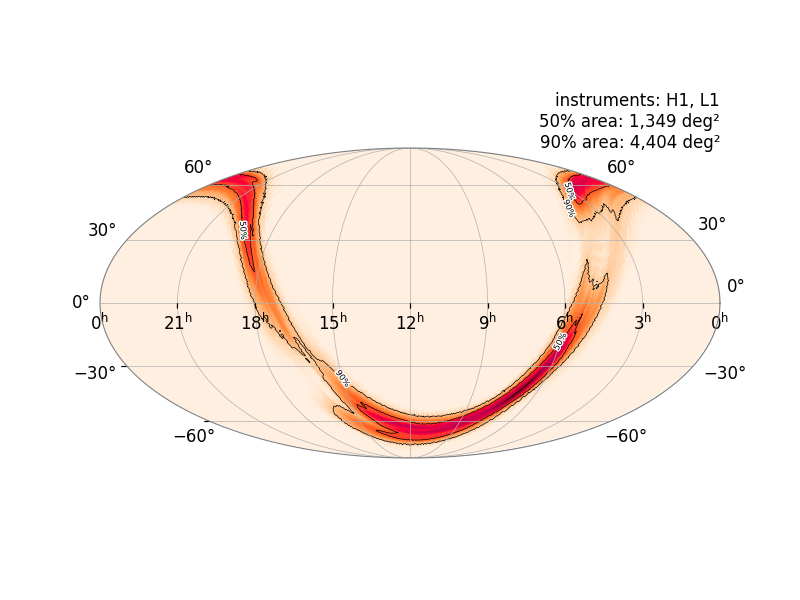
Caption: Sky localization by AMPLFI for gravitational wave candidate S250830m identified on August 30th, 2025. Aframe was the first pipeline to report the event 11.6 seconds after the merger time. Sky localization and source parameters were provided by AMPLFI 3 seconds later.